Company3 min read
Novo is now Thereby
A new name for the work firms already rely on us for, and for where we are taking it next.
On this page
A name equal to the work
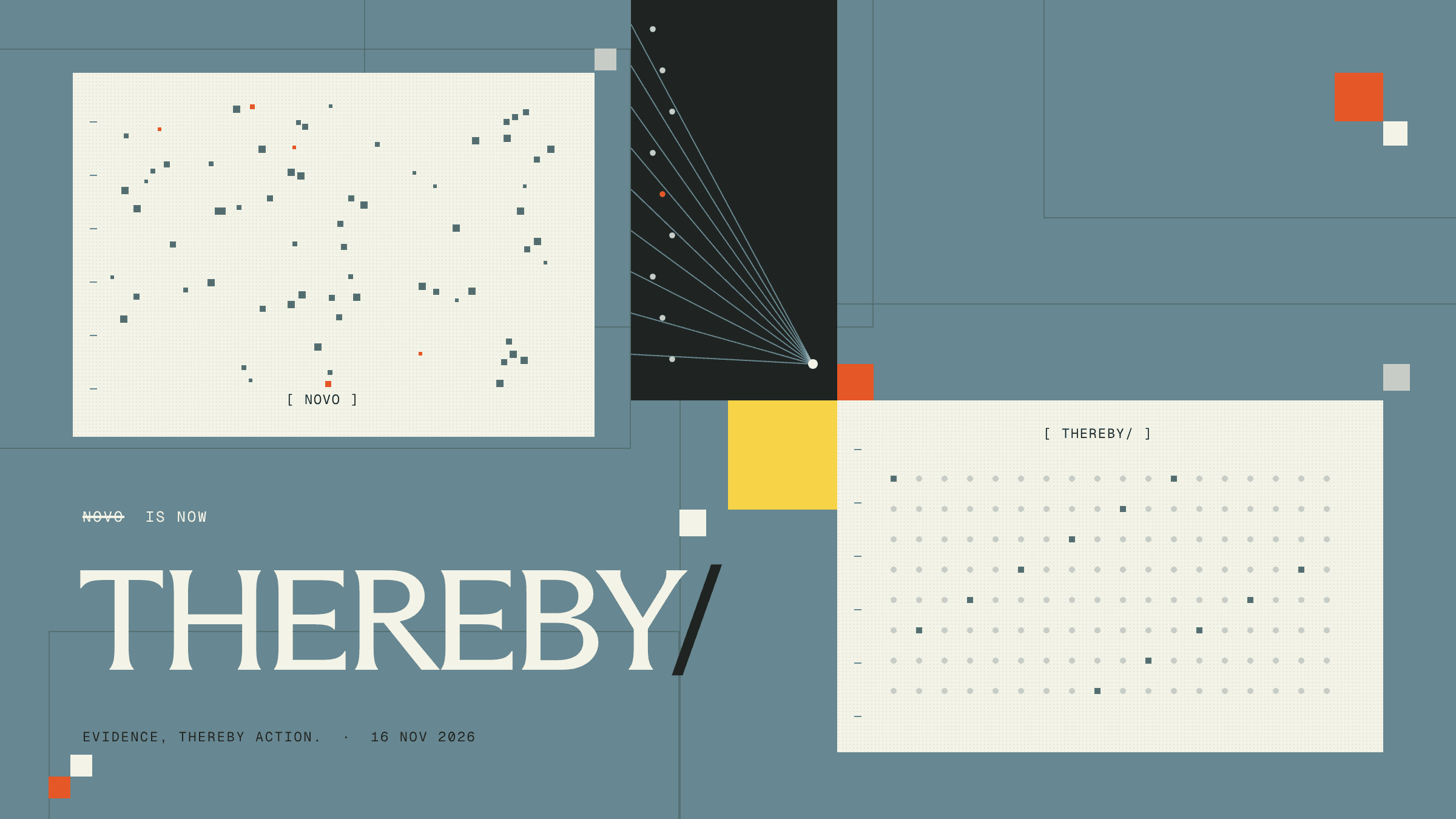
Today we’re changing our name from Novo to Thereby.
The firms we work with no longer come to us for software that reads medical records. They come to us for the outcome: a complete file, a chronology cited to the page, a demand ready for an attorney’s signature. Our new name says so.
A fresh look, from the beginning
When we started the company in 2025, we named it after de novo, the standard under which a court looks at a question afresh, owing nothing to the decision that came before. That was our ambition for personal injury work: to take a fresh look at the most manual parts of a case file, the records requests, the medical chronology and the demand, and rebuild them from the beginning.
At the time, the open question was whether AI could read a medical record reliably at all. A year later that question has been answered, and our customers have moved on to a harder one. Will the work be complete, cited and in the form my firm uses, on the day my case needs it? That is a question about outcomes rather than technology, and it is the one we want to be judged on.
The name had a practical problem too. Novo is shared by a great many companies, which makes it hard to find and harder to recommend. As the firms we serve have grown, we wanted a name that could carry the work as clearly as the work carries itself.
The case is the unit of value
Legal technology has largely been sold the way all software is sold: by the seat, and increasingly by the token. Both models price access. They cost the same whether a case moves forward or waits on someone’s desk, and they leave the firm to turn a tool into a result.
We think that model is ending. As the cost of AI falls, access to it stops being worth paying for, and what keeps its value is finished, accountable work. So we price per case, at published rates locked for the year, and we hold ourselves to what the case needs rather than to how much software was used along the way.
Your standard, not ours
As we work with larger firms, we see the same thing again and again: the best firms already have a way of doing things. They have a format for a chronology, a structure for a demand and a process for chasing records. Rather than ask them to adopt ours, we are building to theirs.
That begins with record retrieval, our newest product, which takes records requests off your team’s desk entirely: we request, follow up with providers and show you every step until the file is complete. It continues with medical chronologies and demand letters built to a firm’s house style, and with Case Chat, which lets your team question the whole file, coming soon.
Evidence, thereby action
Thereby is a word about consequence. It joins what was done to what it made possible: the records, and thereby a complete file; the chronology, and thereby a demand ready to send; all of it, and thereby less time on desk. The phrase has stood at the foot of every page of our site. Now it is our name.
The identity follows the same idea. The slash in T/ and THEREBY/ leaves the word open, mid-sentence, because what matters is what comes next. Everything else is paper and ink, so that the evidence stays the most prominent thing on the page. We wrote more about it in A new look for Thereby.
What follows
Everything your firm has in motion with us carries on exactly as before, with the same team behind it. Over the coming weeks we’ll be in touch with firms directly about retrieval workflows, chronologies and demands built to their own standards.
We are grateful to every firm that has built this with us since the beginning. The work ahead is larger than the work behind us, and we look forward to showing you what follows.
More from the blog
All posts →Bring us a case.
See what it feels like when the follow-up isn’t yours. We’ll run it through Thereby and walk your team through the output, record by record. Then you decide.