[PERSONAL INJURY · MOTOR VEHICLE]
Car accident cases
Most car cases turn on a handful of facts: the impact, the coverage, and whether the treatment record tells one continuous story. These are the records that prove each one.
Last reviewed
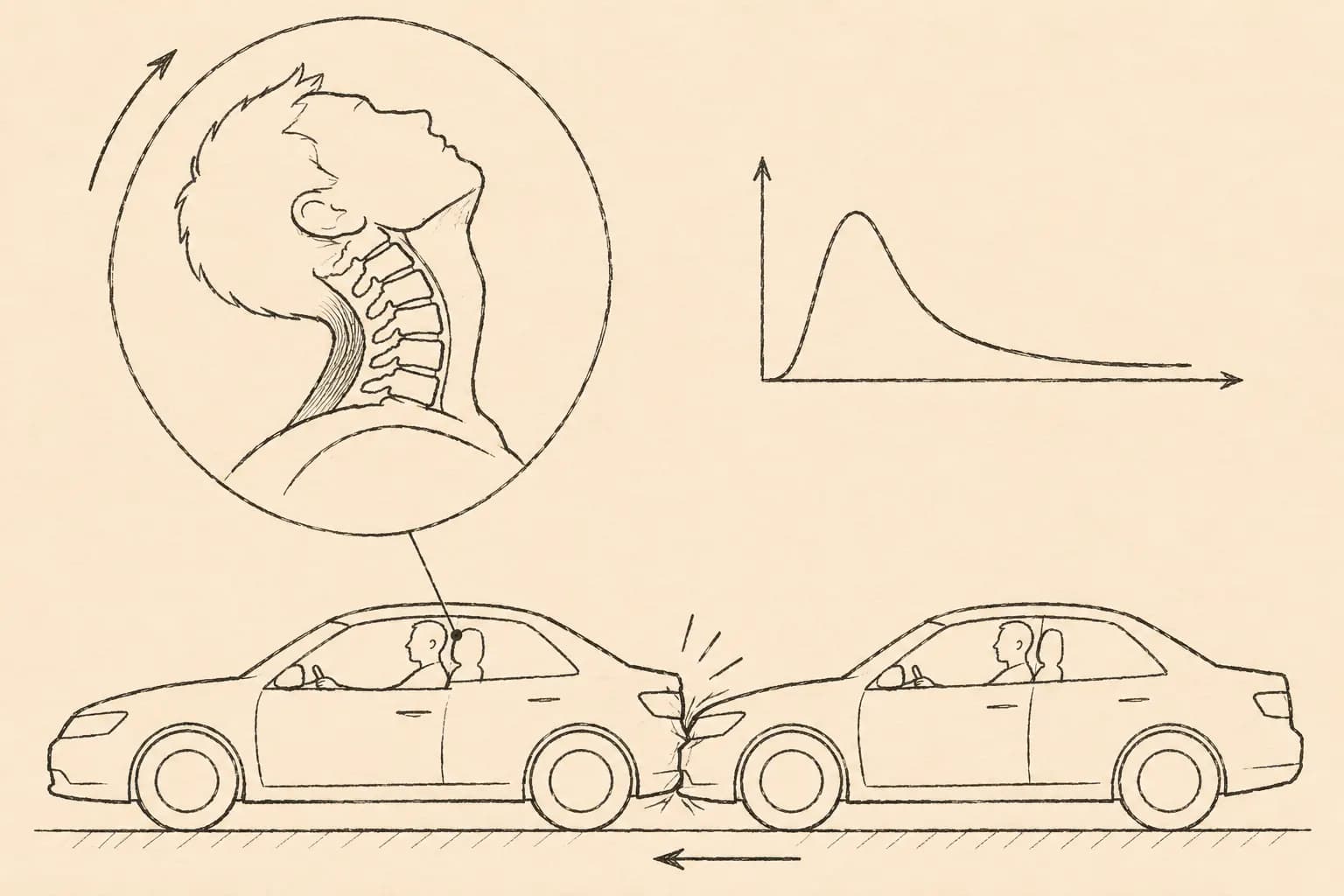
The records that decide it
Rental, passenger, taxi, teen and elderly drivers and driver-assist cases all start here; the facts below change which records matter most.
Crash report, citations and their outcome
Held by Investigating agency, court
Collision type (rear-end, head-on, T-bone, left turn, rollover, sideswipe, multi-vehicle), point of impact, citations, admissions and witnesses. Whether the citation was paid, pleaded, dismissed or is still pending.
Often missing. The citation outcome is rarely in the file; it comes from the court, later.
Event data recorder (EDR) download
Held by Vehicle owner, insurer, salvage yard
For light vehicles built since 1 September 2012 that have a recorderSource 1 § 563.3: 49 C.F.R. § 563.3, Event data recorders: application, it captures speed, throttle, brake use and driver seat-belt status before the crashSource 2 § 563.7(a): 49 C.F.R. § 563.7, Event data recorders: data elements.
Often missing. The vehicle is often repaired, totaled or sold before anyone downloads it.
Photos, repair estimate and property damage
Held by Client, insurers, body shop
Repair hours, airbag deployment and towing. Low property damage plus soft-tissue injuries is the profile insurers treat as a minor-impact case.
Video and 911 audio
Held by Nearby businesses, transit, dispatch
Shows the light phase, speed and what the other driver was doing.
Often missing. Business video is often overwritten within days.
Impairment and aggravating facts
Held by Investigating agency, court, phone carrier
Blood alcohol, field sobriety tests, arrest and the outcome of any charge; phone use, speeding, road rage or drowsiness, each with its source. Hit-and-run cases need the report date, proof of contact and an independent witness.
Every available policy
Held by Insurers
The at-fault driver’s and owner’s policies, PIP or MedPay, and the client’s UM/UIM, plus household vehicles, resident relatives, an employer’s policy or a rental agreement that may stack.
Often missing. Underinsured claims can depend on a limits tender and consent to settle before the liability claim closes.
Medical records and itemized bills, from the first visit
Held by Every provider, including ER and EMS
Under HIPAA a provider must act on a patient’s access request within 30 days, with one 30-day extensionSource 3 § 164.524(b)(2): 45 C.F.R. § 164.524(b)(2), Access of individuals to protected health information: timely action. In Texas, a provider with an electronic records system must provide an electronic record within 15 business days of a written requestSource 4 § 181.102(a): Tex. Health & Safety Code § 181.102. Ask for billing separately; it is often a different department.
Often missing. Imaging films, PT daily notes and the bill that matches each visit are the pieces most often missing.
How the chronology is built
Every page of treatment is dated, cited and put in order, so the demand can show one continuous course of care from the crash forward.
Every encounter, in order and page-cited
Every encounter, diagnosis, procedure and bill, in order and page-cited.
Prior conditions, separated
Treatment before the incident sits apart from the injury, so causation reads cleanly.
Every bill tied to its visit
Every charge tied to its encounter. A bill with no visit note gets flagged for request.
Conflicting dates resolved, originals kept
When a record’s own dates conflict, the entry uses the right one and keeps the original visible.
What moves the number
Value comes from facts written where an adjuster can count them.
- No unexplained gaps
- Each break in treatment, with its dates and the reason from the record (insurance denial, childcare, provider availability). If there is no reason, know that before the adjuster does.
- Prognosis and impairment in the providers’ words
- A prognosis, the date the client reached maximum improvement, any impairment rating and work restrictions. A permanent injury with no rating is a fix to make before the demand.
- What changed in daily life
- Duties the client kept doing in pain, and activities stopped or reduced, each confirmed in a provider note rather than only in intake.
- Aggravation of a prior condition
- A provider’s words saying the crash aggravated a prior condition, with before-and-after imaging of the same body part.
- Every scored fact stated plainly
- Many insurers score bodily-injury claims with software, so each diagnosis, treatment and lasting limitation should be written out where an adjuster can enter it. See how Colossus reads a demand.
Where cases go wrong
A minor-impact file with no medical narrative
Low property damage invites a low offer. Objective findings, radiology wording and the referral trail have to carry the case.
Missing the coverage that stacks
Household and employer policies are easy to miss at intake and hard to add after a release.
How to use this page
This is a records checklist for plaintiff firms, not legal advice. Federal rules are quoted from eCFR with the date we read them. State law (deadlines, fault rules, caps, notice requirements) varies and is covered on the state-law pages.
Sources
49 C.F.R. § 563.3, Event data recorders: application · eCFR (up to date as of 2026-11-04)
“This part applies to the following vehicles manufactured on or after September 1, 2012, if they are equipped with an event data recorder: passenger cars, multipurpose passenger vehicles, trucks, and buses with a GVWR of 3,855 kg (8,500 pounds) or less …”
Checked
49 C.F.R. § 563.7, Event data recorders: data elements · eCFR (up to date as of 2026-11-04)
“Table I … Speed, vehicle indicated … Engine throttle, % full (or accelerator pedal, % full) … Service brake, on/off … Safety belt status, driver.”
Checked
45 C.F.R. § 164.524(b)(2), Access of individuals to protected health information: timely action · eCFR (up to date as of 2026-11-04)
“the covered entity must act on a request for access no later than 30 days after receipt of the request … the covered entity may extend the time for such actions by no more than 30 days.”
Checked
Tex. Health & Safety Code § 181.102 · Texas Legislature (statutes current through the 89th Leg., 2nd C.S., 2025)
“if a health care provider is using an electronic health records system that is capable of fulfilling the request, the health care provider, not later than the 15th business day after the date the health care provider receives a written request … shall provide the requested record to the person in electronic form”
Checked
Bring us a case.
See what it feels like when the follow-up isn’t yours. We’ll run it through Thereby and walk your team through the output, record by record. Then you decide.